


Atticus Finch. An icon of justice and moral integrity
Atticus Finch stands out among fictional characters as an icon of moral integrity, for the fight for equality under the law and justice. He is a steadfast and unshakable figure who embodies the principles of justice and morality. As the protagonist of To Kill a Mockingbird (Harper Lee, 1960), a novel often classified as Southern Gothic and a Bildungsroman, Atticus has left an indelible mark on literature. Narrated by his daughter Scout, the story recounts how Atticus, a lawyer in the fictional town of Maycomb, Alabama, defends a black man falsely accused of raping a white woman during the Great Depression, in a context of deep racial segregation.
“In Alabama in 1935, or even in 1960, that was no small achievement. The ‘code’ of his time and place required that a white woman’s word always be accepted and that a black man was never to be trusted”. (Steven Lubet, Reconstructing Atticus Finch, Michigan Law Review, Vol. 97, No. 6, 1999)
Finch represents justice and moral integrity, as a model of virtue and a guide for future generations. He is a widowed lawyer caring for his two children—Scout and Jem—, who, from the first pages of the novel, displays firm moral principles and an unbreakable ethical code. Although he does not undergo significant change throughout the story, he is responsible for the profound change in his children and, on a broader scale, in society, as manifested in the town of Maycomb.

“You never really understand a person until you consider things from his point of view… until you climb into his skin and walk around in it”. (Harper Lee, To Kill a Mockingbird, 1960)
He also represents impartial justice. He is willing to defend Tom Robinson, regardless of his economic status, skin color, or political views. As Steven Lubet argues, “whether Tom was innocent or guilty, Atticus undoubtedly fulfilled his obligations under the standard conception of professional ethics”. The message is even more powerful knowing that Tom has been falsely accused of rape by a white woman just for racial prejudices. This stands out as an accusation that, from the narrator’s perspective—her daughter Scout—, is clearly unfounded, although the town is content with having found someone to blame.
Atticus is a deeply complex character who challenges the social norms and conventions of his time. Even his own children, initially feel ashamed of their father because his behavior contrasts with that of other men in town. Scout, narrating the story years later, acknowledges the shame they felt because their father did not behave like other fathers—he neither hunted nor fished, and most notably, he firmly defended a black man in a trial that shook the racial prejudices of Maycomb.
“The one thing that doesn’t abide by majority rule is a person’s conscience”. (Harper Lee, To Kill a Mockingbird, 1960)
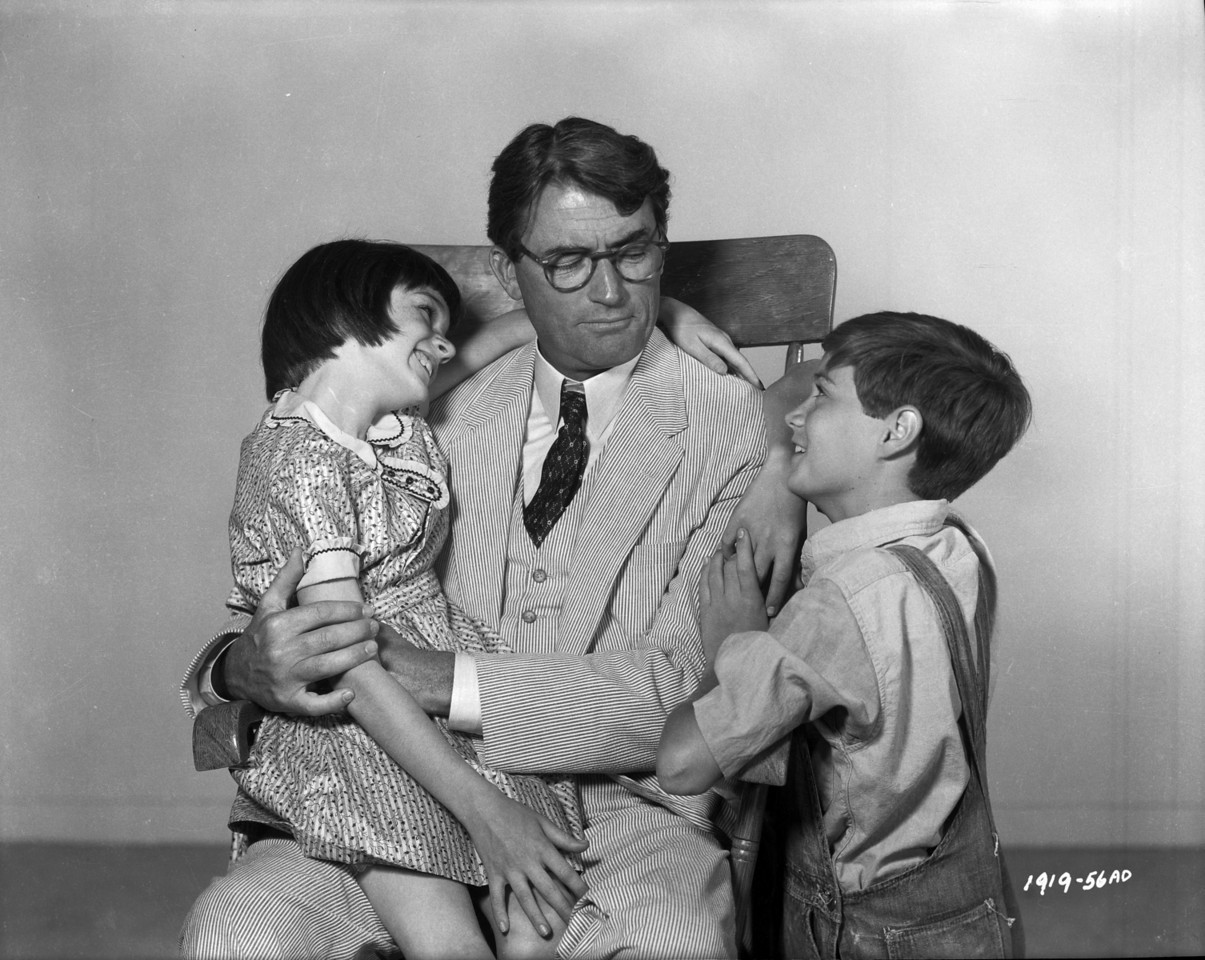
By the end of the novel, the children’s perspective has completely shifted, evolving from deep embarrassment to devout admiration for their father. Although Atticus is the protagonist and driving force of the story, his character is static, meaning he does not undergo significant changes throughout the narrative. His solid beliefs and strong moral code remain stable from beginning to end.
While primarily a static character, Atticus also has a symbolic component. He represents the novel’s fundamental themes, such as social justice, moral integrity, and the fight against racial prejudice. His presence in the story is more than that of a simple lawyer; he is a symbol of what justice should be in its purest form.
Historical Context and Relevance
To understand the greatness of Atticus Finch as a character, it is necessary to grasp his historical context. In the 1930s, the deep racial segregation in the United States made actions like Atticus’s true challenges to the social norm. Defending Tom Robinson, a black man, was seen as a betrayal to the white community, and perhaps to a broader political or societal sphere. Atticus defies this stigma with humanity and dignity, becoming a role model—with Sage archetype—not only for his children but also for the Maycomb community, and the reader.
His defense of Robinson is not just legal but also moral, insisting that justice must prevail over social, racial, and economic prejudices. In this sense, Atticus Finch becomes a beacon of hope in a world that too often surrenders to hatred and discrimination.
Appendix: Similar characters with a resemblance of Finch
Jake Brigance, A Time to Kill (John Grisham, 1988)

Jake Brigance, the protagonist lawyer in A Time to Kill (John Grisham, 1988), shares many similarities with Finch. Like Atticus, Brigance is a Southern lawyer defending a black man in a trial with clear racial connotations. Carl Lee has killed the two white supremacists who brutally raped his daughter, and Jake faces the challenge of defending him in a legal system plagued with racism. “This was Mississippi, where for years whites shot blacks for any reason or no reason and no one cared; where whites raped blacks and it was considered sport; where blacks were hanged for fighting back”, A Time to Kill (John Grisham, 1988). Both characters represent a similar moral strength and unwavering commitment to justice, though they operate in a world still grappling with racial inequalities.
Henry Drummond, Inherit the Wind (Jerome Lawrence and Robert E. Lee, 1955)

Henry Drummond is another character who shares Finch’s moral strength. Henry appears in the play Inherit the Wind (Jerome Lawrence and Robert E. Lee, 1955), defending freedom of thought and creed, and fighting for people’s right to be wrong. In the play, Henry defends Bertram Cates, a schoolteacher accused of violating state laws by teaching his students about Darwin’s evolution theory in the 1920s. Despite the difficulties and rejection he faces, Drummond, like Finch, is a passionate advocate for moral justice, even if his defendants may be wrong or he may disagree with their way of thinking, as he confesses at one point during the play: “Brady had the same right as Cates: the right to be wrong!”.
Conclusion
Atticus Finch stands as a hero of literature, a symbol of justice, integrity, and moral courage. His figure transcends fiction to become a role model for any society that values equality and human rights. Through characters like Finch, their authors challenge us to question our own norms and prejudices, advocating that true justice lies not in what the majority considers right, but in what is morally just.
 Copy Lozano